Miniondle research notebook
Clue Lab
This lab measures the deduction hidden inside Miniondle. It tests every possible opening Minion against every reviewed answer using the production Eyes, Hair, Build, Gear, Credits, and Name rules. The interactive version also compares any two roster records and links to the evidence stored for the selected artwork and traits.
What the reviewed answer roster shows
Hair and Build are less balanced. Twenty-eight reviewed answers use Spiky hair, while 19 use Covered and 15 use Combed. Build ranges from 27 Medium records to five Slightly tall records, with 12 Unknown records retained rather than invented from unclear artwork. The lab exposes these cluster sizes because a green tile is only as useful as the branch it leaves behind.
Best information starters in this snapshot
“Average left” is the mean number of still-possible answers after the first row, with an immediate solve counted as zero. “Worst case” is the largest branch that any one feedback pattern can leave. Lower is better. The calculation judges clue coverage only; it does not assume that a particular portrait is easy to recognize.
| Opening guess | Average left | Worst case | Distinct patterns |
|---|---|---|---|
| Fred | 4.94 | 11 | 25 |
| Vincent | 4.94 | 11 | 25 |
| Chris (Mooned) | 5.13 | 9 | 23 |
| Arthur | 5.84 | 10 | 23 |
| Chuck | 5.84 | 10 | 23 |
Fred and Vincent currently tie because the five non-name clue comparisons partition the answer roster identically for them. Chris (Mooned) has a slightly larger average branch, but a smaller worst case. That tradeoff is why the lab publishes both measurements rather than declaring one universal “best guess.” The live table recalculates from the shipped reviewed data whenever the roster changes.
How the benchmark is calculated
- Choose one playable record as the hypothetical opening guess.
- Compare it with every eligible answer using the exact game function. Eyes, Hair, and Build require equal labels. Gear matches when the records share visible equipment—or when both reviewed lists are empty. Credits matches the number of stored credited titles, not the titles themselves.
- Group answers that return the same five-tile feedback pattern. Each group is a branch the player could still face before guess two.
- Average the surviving branch sizes across all eligible answers, counting a correct opener as zero unresolved candidates. Repeat for every possible opener, then sort by the smallest average and worst-case branches.
What this analysis does not do: it does not use character fame, portrait recognizability, search behavior, or the future schedule. Picture-specific overrides still apply to scheduled alternate artwork. The benchmark is a transparent snapshot of the reviewed clue model, not a promise that every daily image has equal difficulty.
Reviewed source ledger
The interactive lab includes a collapsible ledger for all 82 answer-eligible Minion records. Each entry publishes the normalized clue labels used by the benchmark, the reviewed character page, and the exact image reference. Raw research excerpts are not republished as page copy; the displayed explanations are concise project-written summaries tied to those sources.
Fred
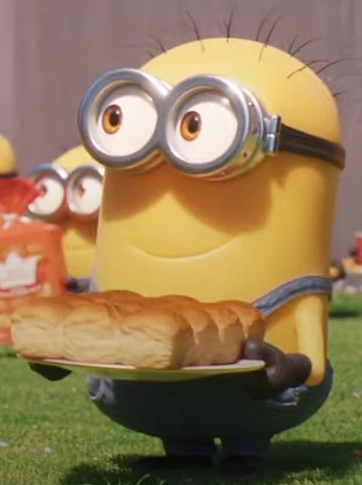
Two-eyed · Spiky hair · Medium build · No scored gear · 2 credited titles
Vincent
One-eyed · Spiky hair · Medium build · No scored gear · 2 credited titles

Chris (Mooned)
Two-eyed · Spiky hair · Medium build · No scored gear · 1 credited title

Review and source policy
Each playable record stores a character-page source, the exact image reference, evidence for every clue field, and a verification status. The interactive lab surfaces the selected records’ source links so a player can audit a surprising classification or send a precise correction. Unknown is kept as an explicit value when the available picture does not support a more confident claim.
Miniondle’s clue model, ranking calculation, daily schedule, progressive reveal, and image-specific review layer are original project work. Franchise characters and source artwork remain the property of their respective rights holders. Report an incorrect clue, missing credit, or rights concern through the Miniondle contact page. Methodology reviewed August 30, 2026.